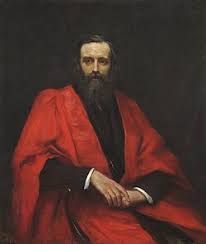
 Arthur Woollgar Verrall (February 5, 1851 – June 18, 1912) was an influential English classical scholar, literary critic, and the first holder of the King Edward VII
Professorship of English Literature at the University of Cambridge.
Arthur Woollgar Verrall (February 5, 1851 – June 18, 1912) was an influential English classical scholar, literary critic, and the first holder of the King Edward VII
Professorship of English Literature at the University of Cambridge.Queer Places:
Wellington College, Duke's Ride, Crowthorne RG45 7PU, UK
University of Cambridge, 4 Mill Ln, Cambridge CB2 1RZ
Ascension Parish Burial Ground, Cambridge, City of Cambridge, Cambridgeshire, England
Arthur Woollgar Verrall (February 5, 1851 – June 18, 1912) was an influential English classical scholar, literary critic, and the first holder of the King Edward VII
Professorship of English Literature at the University of Cambridge.
Born in Brighton, Verrall was educated at Wellington College, where he was a star pupil under headmaster Edward White Benson (later Archbishop of Canterbury). He entered Trinity College, Cambridge, in 1869, graduating as Second Classic in 1872.
Elected a Fellow of Trinity College in 1874, Verrall served as President of the Cambridge Union Society and worked briefly as a barrister before returning to lecture at Trinity in 1877. He taught classics at Trinity for over three decades.
In 1911, he was appointed Cambridge’s first King Edward VII Professor of English Literature. Beyond literature, Verrall is also credited with coining the biological term "synapse" in 1897 at the request of his colleague, neurophysiologist Sir Charles Sherrington.
Verrall was famous—and controversial—for his unorthodox, highly dramatic readings of ancient Greek playwrights, most notably in Euripides the Rationalist (1895). Rather than treating Greek tragedy solely as grammatical texts for textual emendation, Verrall interpreted Euripides as an ironist and rationalist who subtly undermined traditional Greek myth and religion from within.
In 1882, Verrall married Margaret de Gaudrion Merrifield, a lecturer in classics at Newnham College. Both Arthur and Margaret were deeply engaged in the Society for Psychical Research (SPR). Following Arthur's death in 1912, Margaret and their daughter Phoebe were involved in the famous "cross-correspondence" automatic writing experiments, claiming to receive post-mortem communications from Arthur and other deceased Cambridge scholars.
Verrall was elected to the Cambridge Apostles in 1871 while an undergraduate at Trinity College.
The Apostles were an elite, highly secretive debating society that brought together Trinity and King's College scholars. The group emphasized absolute intellectual candor, questioning established orthodoxies in religion, philosophy, and social ethics.
The Apostles’ atmosphere of skeptical inquiry directly shaped Verrall's iconoclastic approach to literature. His radical reinterpretation of Greek plays—stripping away pious tradition in favor of intellectual rationalism—reflected the core Apostolic ideal of challenging established authority.
While there is no direct archival evidence that A.W. Verrall personally identified as homosexual or engaged in same-sex relationships—he lived a conventional marital life with Margaret Merrifield—his life and career were deeply embedded in the late-Victorian queer intellectual network at Cambridge.
During Verrall's tenure in the 1870s and beyond, the Apostles served as one of the primary spaces in Victorian Britain where same-sex romantic attachments and homoerotic ideals were openly discussed and tolerated.
Figures within Verrall's Apostolic circle—such as Oscar Browning, Henry Sidgwick, and later Goldsworthy Lowes Dickinson—promoted ideals of "Greek love" and intense male romantic friendships as superior forms of intellectual and emotional bonding.
As a schoolboy at Wellington College, Verrall was the favorite pupil of headmaster E.W. Benson. Benson was known for forming emotionally intense homosocial bonds with select male students, a dynamic that was common in 19th-century public schools and Oxford/Cambridge colleges.
During his time as a Trinity Tutor (1889–1899), Verrall served as the personal college tutor to the young Aleister Crowley.
In late 19th-century Britain, classical scholarship on ancient Greece was the primary cultural frame through which early defenders of same-sex desire (such as John Addington Symonds and Walter Pater) articulated homosexual identity. As a prominent Hellenist at Trinity, Verrall operated at the heart of the institution that incubated Victorian "Uranian" classical thought, bridging the gap between rigorous academic Greek philology and the modernizing, humanistic literary culture of early 20th-century Cambridge.
References:
 The Cambridge Apostles, 1820-1914: Liberalism, Imagination, and Friendship in British Intellectual and Professional Life 1st Edition by W.C. Lubenow |
Other references:
Support this project
This website is a passion project researched, developed, and funded entirely by me. If you find the content valuable and would like to help support the ongoing research and hosting costs, any contribution is deeply appreciated.
Thank you for keeping this independent resource alive!
My books on Amazon: Elisa Rolle's books